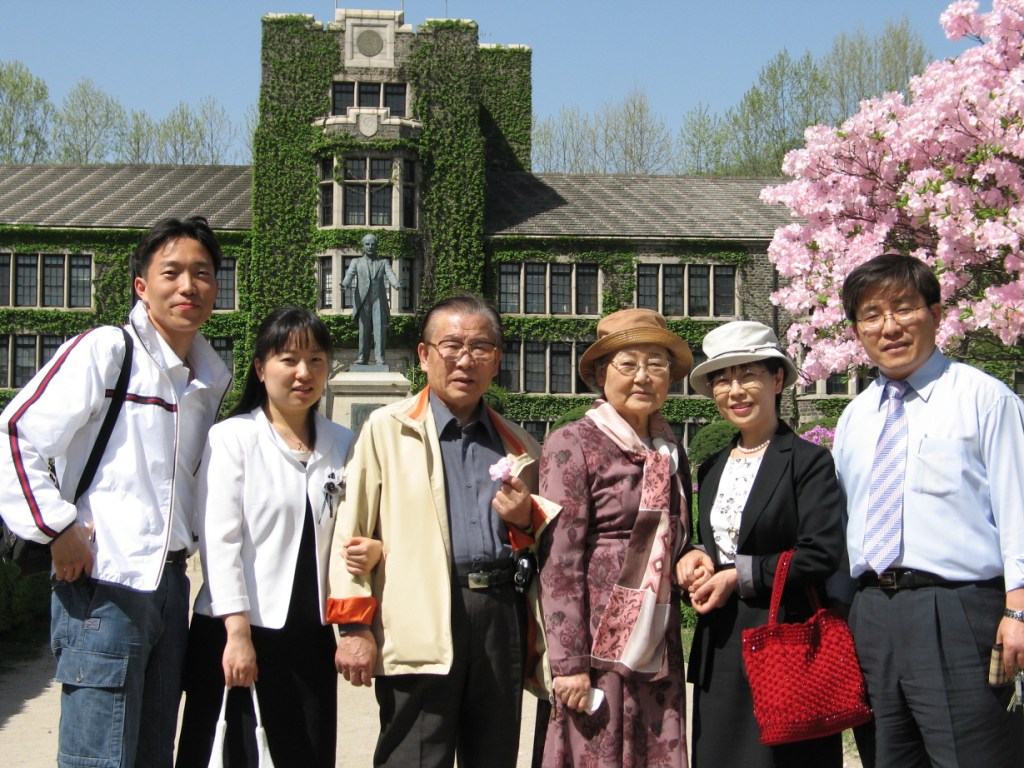
*From right: my father, mother, grandmother, grandfather, my sister, and me—three generations in one frame.
I have been reading Mater 2-10 (철도원 삼대), a novel by Hwang Sok-yong.

It is the story of three generations in one family of railroad workers. It is one family's story, but through the image of the railroad, it becomes a story of modern Korean history, told from the ground up, from the lives of ordinary laborers.

The first generation is the grandfather, Lee Baek-man. During the Japanese occupation, the railroad was a tool of exploitation. He worked inside that system. He lived with discrimination and oppression. He chose silence, not because he did not feel the injustice, but because he chose survival. He chose to feed his family. He chose to endure in silence.

The second generation is the father, Lee Il-cheol. He followed his father into railroad work, but he did not remain silent. He joined labor movements and independence struggles. For this, he was arrested, tortured, and imprisoned. In the end, he made the painful choice to defect to North Korea.

The third generation is the son, Lee Ji-san. He also became a railroad worker. But the world he faced was harsh. Because of his father’s ideological choice, he belonged fully neither to the South nor to the North. Wherever he went, he lived as an outsider, a stranger.

The one who remembers and tells this story in the present is Lee Jin-oh, Ji-san’s son. He is a worker who has been unjustly fired. He stages a one-person protest on top of a factory smokestack. Standing high above the ground, he looks back on the lives of his ancestors. From that lonely place, he asks a simple but piercing question: Where did we come from? And where are we going?

On my birthday, I find myself asking the same question.

My maternal grandfather was born under Japanese occupation and experienced liberation in his twenties. I remember that he spoke Japanese fluently, but he rarely spoke about those years. Silence was his language. He was originally from Haeju, in what is now North Korea. He fled south, served in the South Korean army during the Korean War, and later had a dramatic encounter with Jesus Christ. He became a Methodist pastor, and wherever he served, revival followed.

My father’s generation came of age just after the Korean War. He was born the son of a tenant farmer. He lost his mother in elementary school and suffered greatly under a stepmother. His childhood was marked by poverty and hardship. Yet the church embraced him with love. He later sensed a calling and became a Methodist pastor. He lived through authoritarian regimes and watched the church’s vitality slowly decline.

Then there is me. I grew up during a time of rapid economic growth. Korea hosted the Asian Games and the Olympics. New cities rose everywhere. In my teenage years, I wandered spiritually. I looked critically at the church and at my parents’ ministry. I told myself I would live differently.

After college and military service, I came to the United States for graduate studies in my mid-twenties. When I look back now, nearly twenty years have passed. I am now the father of five children and a pastor serving three churches. Last year, I became a U.S. citizen.

And I feel my limits. As a pastor, I do not know how to help Methodist churches that are declining nationwide. As a citizen, I do not know how to help a democracy that feels fragile.

My children sometimes ask me,
“Dad, are you happy being a pastor?”
“Do you want me to become a pastor like you?”

And today, on my birthday, I ask myself again:
Where have I come from, and where am I going?

 Abide
Abide 